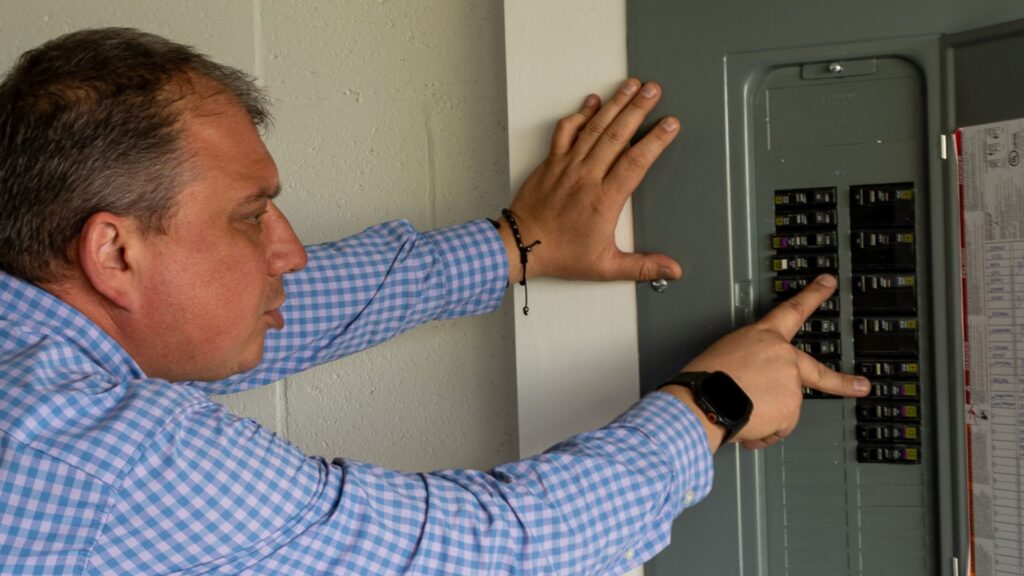
Vic Explaining Panel Upgrade Needs for Bonita Springs

Electrical Planning for Home Remodels and Renovations in Florida

Before you open walls, do you know whether your remodel needs new circuits, a panel upgrade, or permits?
Most homeowners start a remodel thinking about finishes, fixtures, and layout. The electrical questions usually show up later: Can the current wiring stay? Will the panel handle new appliances or lighting? Do kitchens, bathrooms, patios, and outdoor spaces have different requirements? And when are permits part of the job? Those are the right questions to ask early, because remodel work often changes more than appearance. It can change circuit needs, safety protection, and code requirements too. In Naples, permit applications are required for work that installs, alters, repairs, removes, converts, or replaces electrical systems, and the City of Naples says permit applications are submitted electronically through its public portal.

What portable generators and standby generators actually are

A portable generator is a movable backup power source that homeowners deploy when needed. Generac’s comparison guidance describes portable units as the more flexible option, and its transfer-switch materials explain that portable generator setups can be connected more safely to selected home circuits when paired with the right transfer equipment rather than relying only on extension cords.

A standby generator is a permanently installed backup system connected to the home’s electrical system. Generac describes home standby generators as systems that are installed outside the home and designed to provide automatic backup power when utility power is interrupted. Unlike a portable unit, a standby system is built to stay in place, stay connected, and respond automatically.

That difference changes the homeowner experience in a big way. Portable generators are typically about flexibility and lower upfront commitment. Standby generators are about automation and permanence. Generac specifically notes that standby systems require professional installation, while portable generators are more of a quick-access option for homeowners who want backup power without committing to a permanently installed system.

How they work — and why the safety differences matter

Portable generators require manual setup. Homeowners need to bring the unit out, place it correctly, fuel it as needed, start it, and connect the loads safely. CDC says portable generators should never be used inside a home or garage, even if doors and windows are open, and should only be used outdoors more than 20 feet away from windows, doors, and vents because they produce carbon monoxide, which can kill without warning. CDC also recommends using a battery-powered or battery-backup carbon monoxide detector in the home when a generator is in use.

Standby generators work differently because they are tied into the home through an automatic transfer switch. Generac explains that when utility power is interrupted or drops below a preset level, the generator starts and signals the ATS to switch the load from utility power to generator power. That is why standby systems feel fundamentally different during an outage: the system is built to detect, start, transfer, and restore automatically.

Transfer switching matters for portable systems too. ESFI states that transfer switches, whether manual or automatic, are the only way to safely power a home’s electrical system from a generator because they prevent backfeeding. ESFI warns that backfeeding can damage homes, affect neighboring properties, and injure utility workers trying to restore power. That means the portable-vs.-standby decision is not just about convenience. It is also about how safely and cleanly backup power is integrated into the home.

What matters most when choosing between portable and standby backup

The first major factor is how much of the home you need to power. If your goal is to keep a few essentials running during occasional outages, a portable generator may be enough. If your goal is broader coverage with automatic response, a standby generator system is usually the more appropriate category. Generac’s comparison guidance draws that exact contrast, describing portable units as a lower-cost, flexible option for occasional outages and standby generators as the better fit for reliable, hands-off whole-home-style backup.

The second factor is how much manual effort you are comfortable with. Portable generators require setup every time they are used, along with safe placement and connection practices. Standby generators reduce that burden by staying permanently installed and automatically switching the home to backup power when utility service fails. For homeowners who travel often, have medical or work-from-home needs, or simply do not want to manage outage logistics in bad weather, that convenience can be a deciding factor. The automation piece is directly tied to the ATS functionality described by Generac.

The third factor is installation complexity and local requirements. A permanent standby generator is not just a product purchase; it is an electrical and building project. Collier County’s permanent residential generator requirements say installation must be submitted through a combined permit process with applicable permits and can require items such as a site plan, electrical load calculations, riser diagrams, transfer-switch details, and information on location and distances. That is one reason standby systems need more planning up front.

Finally, homeowners should think about ownership over time, not just day-one cost. Portable generators may have a lower entry cost, but they also require storage, manual deployment, and careful operation each time. Standby systems require more upfront investment and professional installation, but they are designed around automatic performance and ongoing integration with the home. Neither option is universally “better.” The right answer depends on the property, the outage risk, the must-run loads, and the kind of backup experience the homeowner actually wants.

How Link33 helps homeowners choose the right backup power path

The best portable-vs.-standby decision is based on the home’s actual needs, not just on whichever option sounds bigger or cheaper at first glance. Link33’s services are built around that broader backup-power conversation, with backup generator installation, automatic transfer switches, and generator maintenance all presented as part of a complete electrical solution. Link33’s services page specifically describes ATS installation and maintenance as a way to ensure seamless switching between utility and backup power during outages.

For some homeowners, Link33 may recommend a standby generator system because automatic operation, convenience, and integration are the highest priorities. For others, a portable-generator strategy may make more sense if the goal is selected-load backup with less permanent commitment. And when homeowners want guidance on trusted equipment, Link33 can recommend proven brands such as Generac while still keeping the recommendation centered on the home, the loads, and the outage plan rather than a one-size-fits-all sales approach.

Ready to Start a New Project?

Fastest way to reach us? Call or text. Prefer forms? We’ve got those too.

Contact Us Today